Makanan Sejuk Beku 101 – A Complete Guide for Modern Malaysian Families
15/01/2026
Behind the Scenes of a Malaysian Frozen Food Manufacturer You Can Trust
17/01/2026
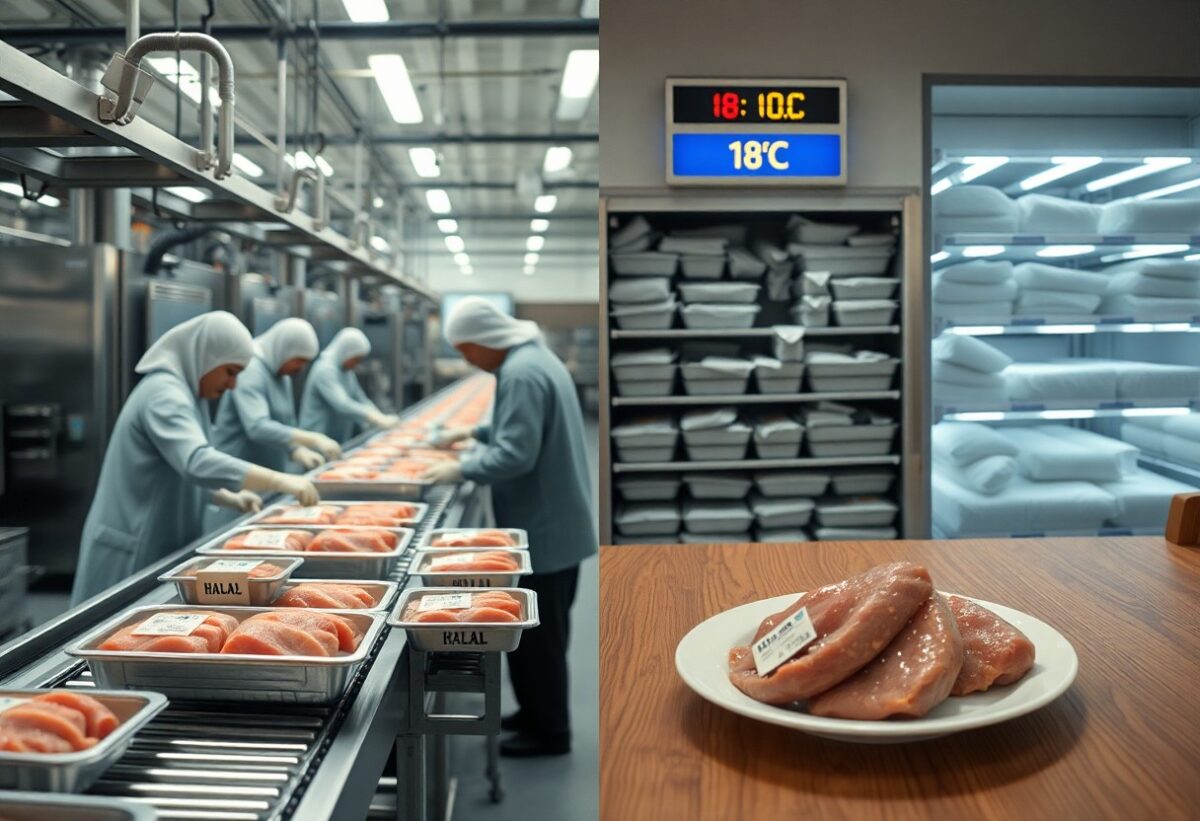
Quality standards in Malaysian frozen food factories ensure you can trust Halal certification, hygienic processing, temperature-controlled logistics and rigorous quality control audits; you’ll learn how regulators, halal bodies and industry best practices protect your food safety and labeling, and how traceability, staff training and regular testing keep products consistent so you can make informed choices for your family or business.
Key Takeaways:
- Halal compliance and regulatory oversight: obtain JAKIM halal certification and comply with Malaysia’s Ministry of Health/FSQD requirements, maintain segregation and halal assurance systems, and ensure trained staff for continuous halal integrity.
- Quality management and hygiene controls: implement GMP, HACCP and SSOPs with defined CCPs, validated freezing/freezer performance (typically −18°C for frozen storage), strict personnel hygiene, pest control and allergen management.
- Traceability, testing and documentation: maintain end-to-end traceability and batch coding, perform routine microbiological/chemical testing, meet labeling/packaging rules, keep detailed records and conduct audits and recall-ready procedures.
Understanding Halal Standards
You need to align factory operations with Malaysia’s halal framework, chiefly MS 1500 and JAKIM requirements, which demand full ingredient traceability, segregation of halal and non-halal lines, documented halal assurance systems (HAS) and staff training. Auditors look for written procedures, supplier certificates, cleaning regimes and physical segregation in cold storage and production. Many frozen-food exporters combine HACCP with HAS to meet both food-safety and religious compliance for local and export markets.
What Makes Food Halal?
You must avoid pork, blood, intoxicants and any improperly slaughtered meat, while ensuring ingredients like gelatin, enzymes, flavors and emulsifiers are sourced from halal-approved suppliers. Cross-contamination controls-separate equipment, validated cleaning and clear labelling-are vital. Seafood is generally accepted under Malaysian practice, but you still need supplier documentation and handling protocols to prove halal integrity through freezing, storage and packaging.
Certification Processes in Malaysia
You start by submitting an application to JAKIM or the relevant State Islamic Religious Council with a halal manual, ingredient list and supplier certificates; typical processing takes 3-6 months. An on-site audit verifies HAS implementation, traceability and segregation. If compliant, certification (commonly valid for two years) is issued, followed by periodic surveillance audits and renewal requirements to keep your frozen-food plant listed as halal-certified.
You should expect auditors to examine supplier contracts, raw-material batch records, allergen and cross-contact controls, cleaning validation, staff training logs and cold-chain documentation. Many factories integrate HACCP records with halal checklists; you’ll need halal certificates for all animal-derived and high-risk ingredients and documented approval for additives. Unannounced inspections and sample testing can occur, and non-conformances require corrective action plans before certification or renewal proceeds.
Quality Control in Frozen Food Production
Quality control connects halal compliance with food safety in your plant, focusing on CCPs such as freezing, storage and packaging. You implement HACCP and ISO 22000, perform temperature mapping to validate cold rooms, and keep frozen storage at -18°C or lower; blast freezers often reach -35 to -40°C to lock freshness. Data loggers and traceability codes let you pinpoint issues quickly and satisfy audits.
Importance of Quality Assurance
Strong quality assurance reduces spoilage, limits microbial risks and protects your brand during JAKIM audits. You cut recalls and customer complaints by monitoring critical limits, documenting corrective actions and validating suppliers; many factories report faster approvals and fewer non-conformities after formal QA programs. Regulatory inspections focus on records, so maintaining batch logs, COAs and chain-of-custody strengthens your compliance posture.
Common Quality Control Methods
Typical methods include continuous temperature logging, ATP swabbing for hygiene, microbiological sampling, metal detection and weight checks. You should deploy in-line metal detectors set to detect 1.5-3.0 mm ferrous, perform weekly ATP or surface swabs, and run microbial tests (e.g., total plate count, Listeria) per lot. Visual inspections, packaging integrity and COA review complete the control suite.
To operationalize these methods, you set daily temperature logs with alerts, calibrate probes every 3-6 months, and adopt a risk-based sampling plan-daily line swabs during product changeovers, weekly finished-product microbiology and monthly environmental monitoring. Shelf-life studies at -18°C are typically 3-12 months depending on product category (seafood 3-6 months, vegetables 8-12 months). Use SPC charts to spot trends and trigger root-cause investigations before faults escalate.
Compliance with Malaysian Government Regulations
When operating in Malaysia you must adhere to the Food Act 1983 and Food Regulations 1985 alongside MS 1500 and JAKIM halal rules; MOH’s Food Safety and Quality Division conducts inspections while local councils issue premises licences. You’ll prepare HACCP plans, maintain traceability records, support periodic halal and safety audits, and manage customs for imports/exports so that validated processes and documentation protect your products from recalls, fines or licence suspension.
Key Regulatory Bodies
JAKIM issues halal certification and conducts facility audits; the Ministry of Health (Food Safety and Quality Division) enforces food safety, inspects plants and reviews HACCP. Department of Veterinary Services manages animal-origin controls and slaughterhouse standards, while Department of Standards Malaysia issues MS and adopts ISO benchmarks. You’ll also work with local municipal councils for operating licences and with Customs on import/export compliance.
Safety Standards and Guidelines
You should implement GMP and HACCP and consider ISO 22000 to align quality systems with MS 1500 for halal handling. Maintain strict cold-chain control – frozen storage at or below −18°C with continuous logging – plus allergen segregation, sanitation schedules, batch traceability and routine microbiological testing to meet MOH and industry expectations.
Validate critical control points by documenting temperature profiles, product core logs and microbial results; use ATP swabs and environmental sampling to verify sanitation. Train staff on sampling frequency and corrective actions, calibrate sensors regularly (quarterly or biannually), and retain records for audit readiness so you can demonstrate effective control during MOH or JAKIM inspections.
Best Practices for Frozen Food Factories
You should embed HACCP, ISO 22000 and Halal process controls into daily operations, maintain the cold chain at -18°C or lower from production to storage, and enforce traceability with batch codes and digital logs. Implement monthly internal audits and quarterly third-party audits, run supplier qualification for raw ingredients, and standardize packaging and MAP parameters to extend shelf life while preventing freezer burn.
Hygiene and Sanitation Protocols
You should ensure strict zoning with separate raw and cooked areas, color-coded tools and footwear change points, and sanitation checklists each shift plus weekly deep cleans. Validate cleaning with ATP swabs and weekly microbiological surface tests, log results digitally, adopt CIP for liquid lines, and apply allergen washdown procedures to control Listeria and other spoilage organisms.
Employee Training and Awareness
Train your staff with role-based modules-2-3 day onboarding for operators and 8-16 hour modules for supervisors-paired with annual refreshers and quarterly competency checks. Provide multilingual materials (Malay, English, Chinese, Tamil), practical demonstrations, and visible SOPs on the line; track completion in an LMS and link training outcomes to hygiene audit scores and near-miss reporting.
You should supplement training with biannual mock recalls and monthly traceability drills aiming to locate batches within two hours, require an 80% pass rate on competency tests, and provide targeted coaching for underperforming staff. Run weekly behavior-based observations, use digital checklists for supervisors, and deploy incentive programs for hygiene and halal compliance to sustain improvements across shifts.
Challenges Faced by the Industry
Several persistent challenges compress margins and raise operating complexity: energy can account for 30-40% of cold-chain costs, skilled refrigeration technicians often require 6-12 months of training, and you must fund recurring halal and FSQD audits while meeting buyer-driven specs for traceability and shelf life.
Market Competition
On the retail front, you compete with cheaper imports from Thailand and Vietnam, growing private-label ranges from chains like Lotus’s and AEON, and aggressive online sellers on Shopee and Lazada; price pressure and faster turnaround demands force you to optimize batch sizes and reduce lead time to retain contracts.
Supply Chain Issues
Cold-chain disruptions-from refrigerated truck shortages to temperature excursions-can drive product loss of roughly 10-20% without tight control, and cross-border clearance or transport delays of 1-3 days often spoil perishable schedules you planned.
In practice you face port congestion at major hubs, regional cold-storage gaps (notably in East Malaysia), and paperwork holdups for export and halal paperwork; mitigating steps include deploying IoT temperature loggers for continuous monitoring, contracted backup reefer capacity, stricter vendor KPIs, and cross-training staff to shorten response times when excursions or documentation rejections occur.
Innovations in Frozen Food Production
Beyond standard controls, you should adopt IQF and blast-freezing technologies-IQF lines commonly handle 1-5 tonnes/hour while blast freezers reach −30°C to −40°C-alongside IoT sensors and blockchain traceability to cut recalls and speed audits; combining AI for predictive maintenance with vision systems for foreign‑object detection helps you reduce downtime and contamination, and modular production cells let you scale capacity without disrupting halal segregation flows.
Technological Advances
You can deploy PLC/SCADA integration with wireless temperature and humidity sensors for 24/7 CCP monitoring, use machine‑vision grading to sort defects at >99% accuracy, and implement AI models that predict compressor faults so you schedule maintenance before failures; pairing robotics for palletizing and automated halal line segregation reduces cross‑contact and improves line throughput with consistent sanitary handling.
Sustainable Practices
You should transition refrigerants from high‑GWP HFCs to CO2 (GWP≈1) or ammonia, install variable‑speed drives on compressors and conveyors, and use waste‑heat recovery and LED lighting to cut energy consumption; combined measures often lower utility intensity by double‑digits and support Malaysia’s net‑zero commitments while preserving cold‑chain integrity for halal compliance.
For more detail, evaluate lifecycle impacts: CO2 refrigeration dramatically reduces GWP versus R404A (≈3,900× higher), solar PV can offset daytime freezer loads, and heat‑recovery systems can supply hot water for cleaning, trimming peak gas or electric use; pilot projects commonly report 15-30% energy savings, so you should run an energy audit and phased retrofits to verify payback in your facility.
Summing up
On the whole, you can trust Malaysia’s frozen food factories to blend Halal-certified processes, strict quality control, traceability and trained staff to safeguard your products. By following JAKIM guidelines, GMP and HACCP standards, your supply chain gains consistent safety, clear documentation and regular audits, helping you meet regulatory and consumer expectations while protecting brand integrity.
FAQ
Q: What specific Halal requirements must frozen food factories in Malaysia meet to obtain and maintain JAKIM certification?
A: Factories must comply with JAKIM Halal Certification procedures and Malaysian Halal standard MS 1500. Key requirements include documented halal control plan, segregation of halal and non‑halal materials and processes, approved halal raw‑material suppliers, verification of slaughterhouses for meat (where applicable), and appointed halal personnel (supervisor/auditor). Cleaning procedures and validated cleaning‑in‑place (CIP) must prevent cross‑contamination; shared equipment requires documented cleaning and inspection between uses. Supply chain traceability and halal chain of custody records are required for all inputs, with batch coding and supplier declarations. Halal labels and logos must follow JAKIM rules and certificate renewal dates must be observed. Routine internal halal audits and readiness for JAKIM or appointed body inspections are mandatory to maintain certification.
Q: What quality management and food safety systems should a frozen food factory implement to control hazards from raw material to frozen storage?
A: Implement a hazard analysis and critical control points (HACCP) plan or ISO 22000 food safety management system alongside Good Manufacturing Practice (GMP), Sanitation Standard Operating Procedures (SSOP), and validated standard operating procedures (SOPs). Identify CCPs such as cooking, cooling, freezing (blast or tunnel), cold‑storage entry, and thawing; set critical limits (e.g., core temperature targets, storage at ≤‑18°C for long‑term frozen goods) and continuous monitoring with calibrated sensors and data logging. Conduct microbiological testing (TVC, Listeria, Salmonella, E. coli), chemical residue and allergen testing, and physical inspections. Validate freezing methods (IQF performance, freezing rate) and shelf‑life through challenge and stability studies. Maintain supplier approval, incoming raw material inspection, lot traceability, corrective action records, preventive maintenance and calibration schedules, and staff food safety training and competency records.
Q: How do regulatory inspections, audits, corrective actions, and product recall procedures work for frozen food factories in Malaysia?
A: Regulatory oversight comes from the Ministry of Health (KKM) under the Food Act 1983 and Food Regulations 1985 for food safety, while JAKIM oversees halal certification. Factories should conduct routine internal audits and host third‑party audits (ISO, HACCP certification bodies, or SIRIM) and be prepared for JAKIM halal audits. Non‑conformities must be documented with root‑cause analysis, corrective and preventive actions (CAPA), verification of effectiveness, and updated records. A documented traceability system enables rapid trace‑back/trace‑forward by batch/lot to isolate affected product. Recall procedures must define roles, decision criteria, communication templates for authorities and customers, logistics for retrieval or disposal, and post‑recall review. Continuous training, management review meetings, and performance metrics (e.g., audit findings, product test failures, temperature excursions) drive improvement and regulatory compliance.